

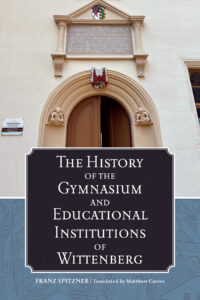
 ST. LOUIS—At a time when renewed interest in classical Christian education is shaping how many families, congregations, and schools approach teaching and formation, Concordia Publishing House announces the release of The History of the Gymnasium and Educational Institutions of Wittenberg, an English translation of Franz Spitzner’s 1830 history of the Wittenberg Latin school.
In the preface, Lutheran scholar Dr. Gene Edward Veith Jr. observes growing concern about the state of modern education: “Today, particularly in the United States, education is in a bad way. . . . Students are graduating . . . hardly able to read and write, unable to think clearly, and utterly ignorant about the world outside of themselves.”
Veith notes that many educational reformers are looking to the past for renewal through the revival of the liberal arts. The classical Christian education movement, and more specifically the classical Lutheran education movement, seeks to recover “the Christian educational heritage that has formed so much of Western civilization . . . integrating rhetorical learning and catechesis,” much like the Wittenberg Latin school once did.
Even as Martin Luther and Philip Melanchthon advanced reform in the church, they also labored to renew the schools of their day. They recognized that a strong primary and secondary education, grounded in Scripture and accessible to both boys and girls, was essential for the church’s life and for the good of society. Their guidance for schools shaped class divisions, curriculum, and teacher expectations. Spitzner’s detailed work opens archival records that trace how these reforms were carried out in Wittenberg and how the Latin school’s rectors and teachers helped form generations of students.
Spitzner’s work traces the gymnasium’s development through eras of dramatic change—the Reformation, the wars of religion, the rise of the Enlightenment, and the growing influence of Prussia. Through conflict, decline, renewal, and growth, the school remained committed to forming students in the liberal arts and the Christian faith.
The History of the Gymnasium and Educational Institutions of Wittenberg is now available through Concordia Publishing House.
Praise for The History of the Gymnasium and Educational Institutions of Wittenberg
“A welcome volume on the reference shelf of every Lutheran educator desiring historical insights that have applications for our current educational landscape.”
—Rev. Dr. Daniel N. Harmelink, executive director, Concordia Historical Institute, St. Louis, Missouri;
president, International Association of Reformation Coins and Medals
“A one-of-a-kind resource for the history of the schools in Wittenberg . . . survey[s] the curriculum and educational philosophy across the various periods of the school’s history, always with a view to the Lutheran Reformation’s goal of training up the next generation in the liberal arts and the Christian faith.”
—Rev. Dr. Gerhard Bode, chairman of the Department of Historical Theology, director of the Center for Reformation Research, Concordia Seminary, St. Louis, Missouri
“A treasure for anyone seeking to understand or revive the Lutheran tradition of classical education.”
—Rev. Joshua Hayes, assistant professor of classical languages and theology, Luther Classical College, Casper, Wyoming